Shiatsu For Horses

With Liz Eddy

Change your language:

Français English
**Insert new item*
*Edit above itemDelete above itemInsert new item*

What is Equine Shiatsu?

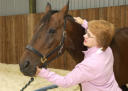
rsz_liz_shiatsu 001 Shiatsu literally means "finger pressure" and is based on the concepts of traditional oriental medicine, similar to acupuncture theory. The basic techniques involve pressure with palms, fingers and thumbs, along with rotations and stretches of legs, neck and tail. This stimulates the body's own self-healing through increased blood circulation, movement of the lymphatic fluid and activating the autonomic nervous system.


Horses particularly enjoy shiatsu as "touch" is a natural language for them.
*Edit above itemDelete above itemInsert new item*

An Equine Shiatsu Practitioner at Work

NEWS - if you want to see a brief session of shiatsu - go to youtube.com and look for "an introduction to equine shiatsu". There you will see me and Po, who has come to live here and be a shiatsu horse! Po is an ex-showjumper who has retired, aged 9, due to an arthritic problem. he is absolutely adorable, plays the clown when getting shiatsu and now has 4 adoring ladies to look after!


Early Summer 2010

I was saddened to hear about the death of one of my favourite shiatsu clients, Flaxman Sid. He was a truly lovely horse and was so easy to work, with from a shiatsu point of view. Often Arabs can be quite difficult because they like to think - possibly are - more intelligent than people, but Sid always told you what he needed and was always willing to try what I asked of him. He was truly a joy to work with.

Another horse who is fun to work with, but for rather different reasons, is Olivia Haddow's Patris Filius. Filius likes to be in control of all situations and often these lead to quite a battle of wills as to whether he is prepared to do as I ask. Sometimes, these debates used to take quite a while. However, having completed Badminton in 2008, he has nothing left to prove and has been downgraded to have some fun at lower levels. He is obviously enjoying the easier lifestyle, as last time I saw him he only tried to bite me once, and even that was half-hearted!

For me, the experience of working with different personalities is what makes this job so enjoyable. Being able to change and adapt to each individual horse is, as far as I'm concerned, one of the important parts of being a good practitioner. Having good theoretical knowledge will only get you so far as the key to good Shiatsu is quality of touch. Every horse is an individual and while working with a horse like Sid makes it all seem so simple, it is also necessary to recognise that horses like Filius just want to have fun in a different way!

Liz


Spring 2010

As a teacher of equine shiatsu, I find that most of my weekends are taken up with the school and so it is true to say that I do not see as many horses as I used to before the school started. However, I feel that it is very important to continue working in order to keep up to date and fresh with my Shiatsu. Every horse that you see will bring something new and for me, that is on of the most fascinating and enjoyable things about this work.

Over the winter, many people were concerned about keeping their horses on what amounted to box rest but now that spring has finally appeared, life is returning to normal. My eventing clients seem to be a little later in getting started this year, but when visiting them for the first time since the end of last season, I am reminded that tightness in the rider is mirrored in the horse! If you have one rider-one horse, then it is often difficult to know who is the chicken and who is the egg, but if you see one rider with several horses and they all have the same problem, then there is not so much doubt! Still, that's what Shiatsu is there to alleviate.

The latest idea which I am working on concerns coloured horses. A few years ago, one of my students did her case studies on mud fever and noticed that if you have a horse with white legs, then there is a definite energetic change where the colour changes. Lately, I have noticed a change and therefore, a sensitivity anywhere on the horse where the colour changes. To be honest, I'm not sure where this is leading but if you have a coloured horse and he is more/less sensitive on the white bits than the coloured bits, I would be most interested to hear from you.

Lastly, although horses are the main part of my work, lately I find myself working on almost as many dogs. Dogs are different to work with but at least you can be inside in the warm!

If you would like to have someone give your animal a Shiatsu, visit www.equineshiatsu.org to find a practitioner in your area.

regards, Liz
*Edit above itemDelete above itemAdd new item*